Todd Miller, PhD
Research Associate, University of Wisconsin, Department of Bacteriology
Harmful algal blooms
![]() |
Harmful algal blooms are large accumulations of algal biomass, often occurring or noticeable at the surface of lakes and oceans. They are primarily a nuisance due to odors and hypoxic conditions produced by their decaying biomass. Some, but not all algae produce toxins harmful to humans, pets, and wildlife. In temperate lakes of North America, harmful algal blooms, particularly toxic blooms, are most often caused by one or more species of cyanobacteria (a.k.a. blue-green algae). These photosynthetic bacteria grow during the warmest times of the year and produce both blue (phycocyanin) and green (chlorophyll) pigments giving them a characteristic bright blue appearance. Cyanobacterial blooms are patchy in nature and can form over the course of days or on hourly time scales simply by accumulating at the surface. For this reason, it is extremely dificult to predict when and where cyanobacterial blooms, or more importantly, their toxins will occur.
I am investigating harmful algal blooms in eutrophic north temperate lakes. The objectives of this work are to 1) identify environmental forces that influence cyanobacterial species composition, 2) characterize controls on spatial and temporal distribution of toxins, particularly at beach and/or swimming locations, 3) develope predictive models of toxin production and fate, 4) improve the use of automated sensors for bloom detection, 5) investigate mitigation strategies for toxic blooms at swimming locations. Below are some descriptions of projects relevant to these goals
Distribution and chemical composition of cyanobacterial toxins in eutrophic lakes
The most commonly encountered (measured?) cyanobacterial toxins in north temperate lakes, especially in Wisconsin, are microcystins and anatoxin-a. In addition, invasive algal species such as Cylindrospermopsis raciborskii recently detected in northern lakes may expand this list to include saxitoxin, cylindrospermopsin and their derivatives. I am characterizing the distribution of these toxins in four eutrophic lakes in south central Wisconsin. A central focus of this work is to identify environmental variables that correlate with toxin concentration, composition and distribution. A larger goal of this work is to improve models that may be used to forecast toxin concentration and fate in the aquatic environment.
Collaborators:
Curt Hedman, Wisconsin State Lab of Hygiene
Lucas Beversdorf, University of Wisconsin Department of Civil and Enviornmental Engineering
Paul Hanson, University of Wisconsin Center for Limnology
Improving the use of in-situ fluorescent sensors on buoys to monitor algal blooms
|
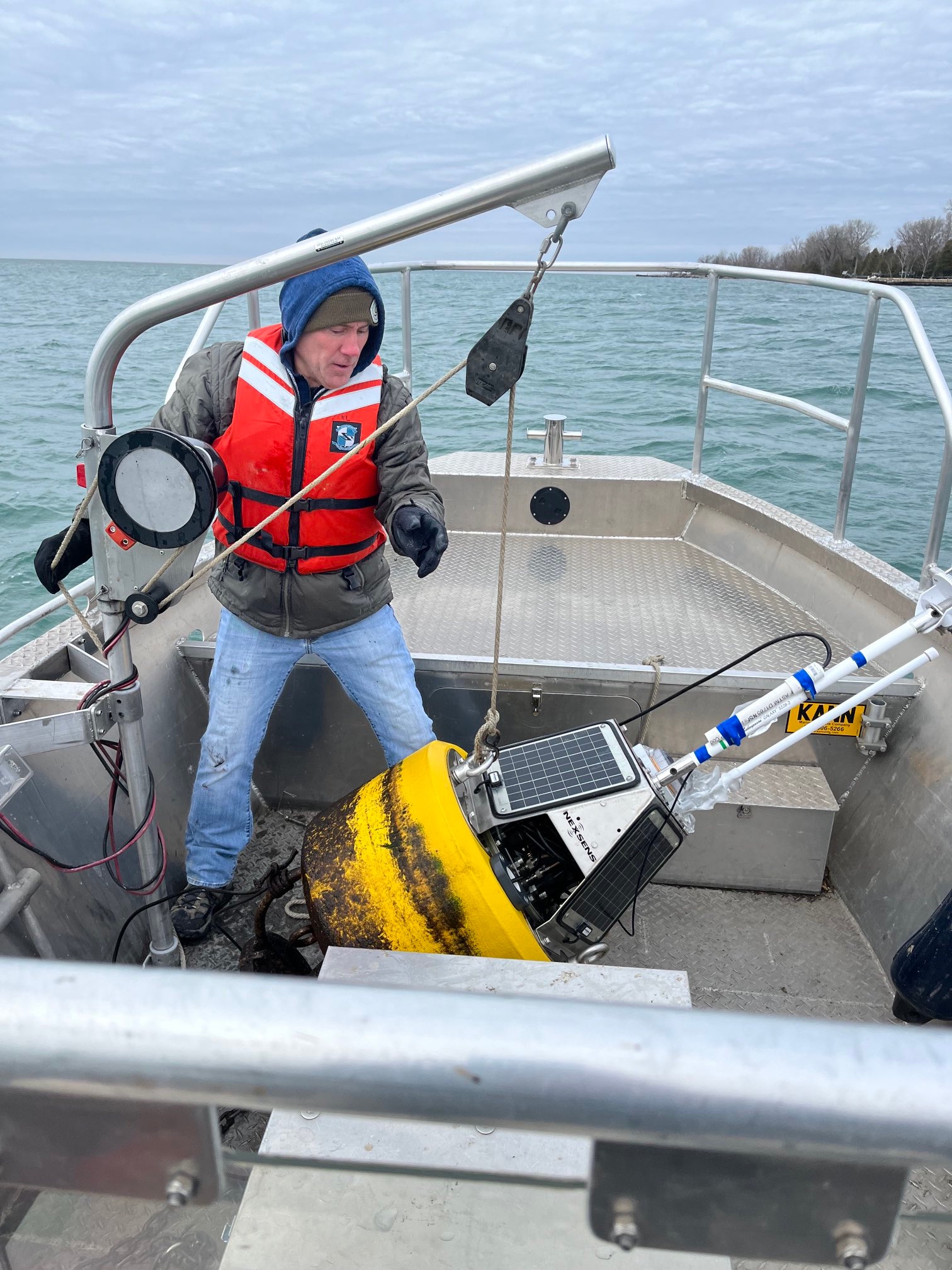
The Lake Mendota Observational Buoy is equipped with chlorophyll and phycocyanin sensors. The buoy is maintained by the LaMEO group at the University of Wisconsin Madison.
|
Algal pigment concentrations, primarily chlorophyll-a, are often used as an indicator of algal biomass. They have been measured for nearly half a century in the laboratory by various means (spectrophotometer, fluorometer, HPLC), but in situ measurements of algal pigments is a relatively new endeavor. It is made possible by use of relatively inexpensive sensors that detect the fluorescent intensity of algal pigments at specified excitation and emission wavelengths. When placed on a buoy or other aquatic structure and connected inline with a data logger and radio transmitter, pigments can be monitored on minute time scales in near real- time. These sensors have the potential to greatly improve our understanding of the timing of factors promoting cyanobacterial blooms and could be used as new monitoring devices to prevent human exposures to toxic algae. Furthermore, multiple sensors placed in vertical or horizontal space constituting a sensor network provides spatial information about algal activity. However, problems arise from the interpretation of sensor data as a direct measure of pigment concentration or even an indirect measure of algal biomass. Algal pigments are subject to photo bleaching from over exposure to sunlight, a process that diminishes fluorescent intensity of pigments thereby underestimating pigment concentrations. In addition, algae, particlarly cyanobacteria almost always exist in large colonies or particles. These particles add a large amount of variability to sensor signals. The size and speed at which these particles pass by sensors are two factors that greatly affect sensor signal variabilty. I am attempting to quantify the effects of some of these factors in order to improve our interpretation of pigment sensor data.
Mendota Buoy data and other weather data from Wisconsin can be accessed through the Ground-based Atmospheric Monitoring Instrument Suite (GAMIS) or The Global Lakes Ecological Observatory Network (GLEON).
Collaborators:
Luke Winslow, University of Wisconsin Center for Limnology
Paul Hanson, University of Wisconsin Center for Limnology
Jordan Read and Chin Wu, University of Wisconsin, Civil and Environmental Engineering
The Global Lakes Ecological Observatory Network (GLEON)
The Lake Mendota Environmental Observatory (LaMEO) working group
Watch a documentary on deployment of the Lake Mendota Buoy!
Drivers of cyanobacteria species composition in eutrophic lakes revealed by automated phycobilli intergenic spacer analyss (APISA)
![]() |
Cyanobacteria can be identified based on an analysis of their phycobilin intergenic spacer sequences. This genomic region consists of two evolutionarily conserved phycobillin genes and a variable (by length and sequene) intergenic region. By comparing these sequences in phylogenetic trees, cyanobacteria can be identified or grouped at a sub-genus level. Alternatively the sequence region can be analyzed by a fingerprinting technique illustrated in the figure to the left. PC-IGS sequences from different cyanobacteria within a water samples are identified based on sequence size, which varies by sub-genus or species after digestion with a restriction enyme. I have used this method to compare the cyanobacteria communities inhabiting four eutrophic lakes in 2008. Interestingly, only four PC-IGS genotypes are shared across all four lakes, even though these lakes share significant water flowage. This suggests that there is greater diversity within cyanobacterial populations than could be recognized by other traditional methods (i.e. microscopy). Furthermore, good correlation was observed between variation in species composition and inorganic nutrient levels across the lakes suggesting that the types of cyanobacteria we observe across lakes are governed by the amount of nutrients lakes recieve. It is known that cyanobacteria, and in general most algae, respond to nutrients. However, this data shows that even realtively small differences in nutrient levels among lakes at the same trophic level regulates cyanobacterial species composition.
|
|
Correspondence analysis of cyaobacterial genotype distribution across lakes. Similarity in genotype structure within lakes is indicated by black squares, whereas, the distribution of specific genotypes across lakes is indicated by colored circles. The position of a genotype symbol relative to lake symbols indicate its' presence within a lake. The inset shows the same ordination, but without genotypes and with nutrients as co-variables. All physical and chemical variables measured were negatively correlated with the first axis. Nitrate (NO2), nitrite (NO3), and soluble reactive phosphorus (SRP) correlate best (R= -0.96, -0.87, and -0.84, respectively). Genotypes of the same genera have disparate distributions across lakes which is presumably influenced by these nutrients. ME=Mendota, MO=Monona, KE=Kegonsa, WI= Wingra. |
The above map shows sampling locations within the Yahara Lakes near Madison, WI. |


.jpg)